


 ปรึกษาฟรี:


 line id: @swcdental


Dental Implants in Rangsit, Pathum Thani
A dental implant is a treatment option for replacing one or more missing teeth.
The implant fixture is placed in the jawbone and acts as a foundation for a dental restoration. Depending on the number and position of missing teeth, an implant may support:
- A single dental crown
- An implant-supported bridge
- A removable implant-retained denture
- A fixed full-arch restoration
Dental implant treatment involves more than placing a screw in the jaw. Successful planning must consider the bone, gums, neighbouring teeth, bite, medical history, expected restoration and the patient’s ability to maintain the implant over time.
Not every missing tooth requires an implant, and not every patient is immediately ready for implant placement. Alternatives may include a dental bridge, a removable denture or, in selected cases, leaving the space under professional monitoring.
A clinical examination and appropriate dental imaging are required before an individual treatment plan can be confirmed.
What Is a Dental Implant?
A dental implant restoration commonly consists of three components.
Implant fixture
The implant fixture is placed surgically into the jawbone.
It is commonly made from a biocompatible material selected for use in bone. During healing, the surrounding bone may form a close connection with the implant surface through a biological process known as osseointegration.
Osseointegration is not guaranteed in every patient. Healing depends on factors including bone condition, implant stability, oral hygiene, smoking, medical health and the forces placed on the implant.
Abutment
The abutment connects the implant fixture to the restoration above the gum.
The type of abutment depends on the implant position, gum shape, restorative design and implant system.
Implant restoration
The visible replacement tooth or teeth may be:
- A crown
- A bridge
- A removable overdenture
- A fixed full-arch prosthesis
The restoration and the implant fixture have different maintenance and repair requirements. Even when the implant remains integrated, the crown, screw, attachment or denture component may require adjustment, repair or replacement over time.
What Problems May Dental Implants Address?
Dental implants may be considered for patients who have:
- One missing tooth
- Several missing teeth
- A gap following tooth extraction
- A removable denture that needs additional support
- Difficulty chewing because of missing teeth
- Teeth with a poor prognosis that are planned for removal
- A missing-tooth space where preparing adjacent teeth for a bridge is undesirable
- A need for coordinated full-mouth rehabilitation
- Bone and oral conditions that are suitable for implant treatment
The presence of a missing tooth does not automatically confirm that an implant is the best option.
The dentist must evaluate the expected benefit, complexity, surgical risk, restorative space, cost, maintenance and available alternatives.
What Dental Implants Cannot Guarantee
Dental implants should not be presented as:
- Permanent for life
- Free from gum disease
- Immune to infection
- Maintenance-free
- Completely painless
- Suitable for everyone
- Able to function exactly like a natural tooth in every situation
- Successful regardless of smoking or oral hygiene
- Ready for a final crown immediately in every case
Implants cannot develop tooth decay because they are not natural teeth. However, plaque-related inflammation and loss of supporting bone can develop around an implant.
The crown, bridge, screws and attachments can also wear, loosen, chip or fracture.
Who May Be Suitable for Dental Implant Treatment?
A possible candidate may have:
- One or more missing teeth
- Adequate bone or the possibility of bone augmentation
- Healthy or appropriately treated gums
- Suitable restorative space
- Acceptable oral hygiene
- Medical health compatible with the planned surgery
- Realistic expectations
- The ability to attend follow-up appointments
- A commitment to long-term cleaning and maintenance
- A treatment plan that considers the complete bite
Age alone does not determine implant suitability.
Growth should be considered in younger patients because an implant does not move or erupt in the same way as natural teeth. Older adults may still be candidates when their oral and medical conditions are suitable.
Who May Need Additional Assessment or Treatment First?
Further evaluation may be required for patients with:
- Active gum disease
- Poor plaque control
- Untreated tooth decay
- Dental infection
- Insufficient bone volume
- Significant gum recession
- Uncontrolled diabetes
- A bleeding disorder
- Immune-system conditions
- Heavy smoking or nicotine use
- Severe tooth grinding
- Previous radiation treatment involving the jaws
- Current or previous antiresorptive medication
- Medical conditions affecting healing
- Pregnancy or possible pregnancy
- Untreated bite problems
- Expectations that cannot be achieved predictably
Patients with gum inflammation or periodontal bone loss may need gum treatment before implant placement.
Smoking does not automatically exclude every patient, but it may affect healing and long-term implant health. Patients should discuss smoking, vaping and nicotine use honestly with the treating team.
Can an Existing Tooth Be Saved Instead?
Before removing a tooth for an implant, the dentist should evaluate whether the natural tooth can be restored predictably.
Possible tooth-preserving treatments may include:
- Dental filling
- Root canal treatment
- Dental crown
- Gum treatment
- Repair or replacement of an existing restoration
An implant is not automatically better than a natural tooth that can be maintained successfully.
Extraction may be considered when the tooth is severely fractured, has inadequate supporting bone, cannot be restored or has an unfavourable prognosis.
Patients can read more about the assessment and removal process on the Tooth Extraction page.
Types of Dental Implant Treatment
Single-Tooth Implant
A single implant and crown may be used to replace one missing tooth.
One potential advantage is that the neighbouring teeth may not need to be prepared in the same way as a conventional tooth-supported bridge.
Planning must consider:
- Available bone
- Distance from neighbouring roots
- Gum shape
- Implant position
- Bite forces
- Crown dimensions
- Appearance
- Cleaning access
Replacing a front tooth may require additional attention to gum levels, bone thickness, tooth proportions and the appearance of the temporary restoration.
Implant-Supported Bridge
An implant-supported bridge may replace several neighbouring teeth using fewer implants than the number of missing teeth.
The number and distribution of implants depend on:
- Length of the missing-tooth area
- Bone availability
- Bite forces
- Restoration design
- Position of the opposing teeth
- Cleaning access
- Individual anatomy
Not every missing tooth requires one implant.
The dentist must design the restoration so that biting forces are distributed appropriately and the patient can clean underneath it.
Implant-Retained Removable Denture
Dental implants may be used to improve the retention and stability of a removable denture.
The denture remains removable for cleaning but connects to implant attachments in the mouth.
Patients should understand that:
- The denture still requires daily cleaning
- The implants and attachments require maintenance
- Attachment components can wear
- The denture may require adjustment, relining or replacement
- Some movement may still occur depending on the design
- The denture must be removed according to the dentist’s instructions
Patients considering a removable option can learn more on the Denture page.
Fixed Full-Arch Implant Restoration
A fixed full-arch restoration uses several implants to support a fixed set of replacement teeth.
This is a complex treatment rather than a routine single-tooth implant.
Planning may involve:
- Assessment of all remaining teeth
- Tooth extraction
- Bone reduction or augmentation
- Implant distribution
- Temporary teeth
- Bite reconstruction
- Speech and appearance assessment
- Cleaning access
- Long-term maintenance
- Possible repair of the prosthetic teeth
Patients requiring extensive treatment may need a coordinated Full Mouth Rehabilitation assessment.
The number of implants, treatment sequence and restoration design must be individualised. Fixed phrases such as “All-on-4 is suitable for everyone” should be avoided.
Dental Implant, Bridge or Removable Denture?
| Topic | Dental implant | Dental bridge | Removable denture |
|---|---|---|---|
| Support | Supported by implant fixtures in bone | Commonly supported by neighbouring teeth or implants | Supported by gums, teeth, implants or a combination |
| Surgery | Usually involves implant surgery | A tooth-supported bridge may not require implant surgery | Conventional dentures may not require implant surgery |
| Adjacent teeth | May avoid preparing healthy neighbouring teeth | Supporting teeth may need preparation | Usually does not require full crown preparation of every adjacent tooth |
| Treatment time | Includes surgical and restorative stages | Depends on supporting teeth and laboratory process | Depends on healing, impressions and adjustment |
| Removability | A crown or fixed bridge is not removed by the patient | Usually fixed | Removed by the patient for cleaning |
| Bone requirement | Requires suitable bone or augmentation | Does not require bone for an implant unless implant-supported | Bone condition affects support and fit |
| Cleaning | Requires cleaning around the implant and restoration | Requires cleaning around and under the bridge | Must be removed and cleaned |
| Maintenance | Implant, gum and restoration require monitoring | Supporting teeth and bridge require monitoring | Denture fit and components require maintenance |
No option is universally best.
The appropriate treatment depends on the condition of neighbouring teeth, bone, gums, bite, general health, budget, expected maintenance and patient preference.
Examination Before Dental Implant Treatment
A dental implant consultation may include a review of:
- Missing teeth
- Remaining teeth
- Gum health
- Bone volume
- Bite relationship
- Available restorative space
- Smile and gum display
- Existing dentures
- Medical history
- Medication
- Smoking and nicotine use
- Previous implant treatment
- Patient expectations
Patients should inform the dental team about:
- Blood-thinning medication
- Diabetes
- Heart conditions
- Immune-system conditions
- Drug allergies
- Previous excessive bleeding
- Osteoporosis medication
- Previous cancer treatment
- Radiation treatment involving the head or neck
- Previous implant complications
- Pregnancy or possible pregnancy
- Smoking, vaping and nicotine use
Do not stop or change prescribed medication without instructions from the prescribing doctor and dental team.
Dental Imaging for Implant Planning
Dental imaging may be used to evaluate:
- Bone height and width
- Neighbouring tooth roots
- The lower-jaw nerve canal
- The maxillary sinus
- Existing infection
- Impacted teeth
- Previous extraction sites
- Implant position
- Restorative space
A panoramic X-ray may provide an overview of the jaws and teeth.
Three-dimensional imaging may be recommended when the dentist needs more detailed information about the implant site and nearby anatomical structures.
CBCT is not automatically required for every dental procedure, but it may be important for selected implant-planning decisions.
Patients can learn about available imaging on the 3D Digital X-ray Center page.
Digital Implant Planning and Surgical Guides
Digital tools may be used to combine information from dental scans, photographs and three-dimensional imaging.
Planning may help the dentist evaluate:
- Proposed implant position
- Implant angle
- Available bone
- Distance from nearby structures
- Position of the future crown
- Restorative space
- Surgical access
- Possible need for augmentation
A surgical guide may be designed in selected cases to transfer part of the digital plan to the mouth.
Guided surgery should not be described as risk-free, incision-free or automatically more accurate in every case. The dentist must still evaluate the bone, gum, access and clinical findings during treatment.
A digital plan is a planning aid rather than a guarantee of the final position or outcome.
Bone Grafting Before or During Implant Placement
A missing tooth area may lose bone after extraction or long-term tooth loss.
If the available bone is insufficient for the planned implant, the dentist may discuss bone augmentation.
Possible approaches include:
- Preserving the socket at the time of extraction
- Adding bone material before implant placement
- Adding bone material during implant placement
- Widening a narrow ridge
- Rebuilding a local bone defect
- Sinus augmentation for selected upper back-tooth areas
Bone grafting is not required for every implant patient.
The need, material, timing and expected healing depend on the defect, implant plan and patient health.
Additional surgery may increase treatment complexity, healing time, cost and possible complications.
Sinus Augmentation
Upper back teeth may be located near the maxillary sinus.
When the available bone height is limited, sinus augmentation may be considered to create or maintain sufficient bone for implant treatment.
The procedure varies according to:
- Existing bone height
- Sinus anatomy
- Implant position
- Presence of sinus disease
- Surgical approach
- Whether implant placement occurs at the same visit
Patients with ongoing sinus symptoms may require further assessment before treatment.
Sinus augmentation is not necessary for every upper-jaw implant.
Dental Implant Procedure at SWC Dental
1. Consultation and initial examination
The dentist evaluates the missing-tooth area, remaining teeth, gums, bite and medical history.
Treatment alternatives and the patient’s priorities are discussed.
2. Diagnostic records
Records may include:
- Clinical photographs
- Digital dental scan
- Dental models
- Panoramic X-ray
- CBCT when clinically indicated
- Bite records
- Relevant medical information
3. Treatment planning
The dentist plans both the implant surgery and the final restoration.
The discussion may include:
- Whether the site is suitable
- Number and position of implants
- Need for extraction
- Need for bone or gum augmentation
- Temporary tooth options
- Estimated healing stages
- Type of final restoration
- Treatment limitations
- Relevant risks
- Estimated fees
- Maintenance requirements
4. Dental preparation
Before implant placement, the patient may require:
- Treatment of active gum disease
- Teeth cleaning
- Dental fillings
- Root canal treatment
- Extraction of a non-restorable tooth
- Improvement of oral hygiene
- Management of bite forces
- Coordination with orthodontic treatment
Not every patient requires all these procedures.
5. Implant placement
Local anaesthesia is commonly used for implant placement.
The dentist prepares the implant site in the jawbone and places the implant according to the treatment plan.
Depending on the case, stitches may be placed.
Patients may feel pressure and vibration during treatment. Implant surgery should not be described as completely sensation-free.
6. Healing and osseointegration
The implant is allowed to heal and develop stability within the surrounding bone.
The healing period varies according to:
- Bone quality
- Implant stability
- Implant position
- Bone grafting
- Medical health
- Smoking
- Infection
- Bite forces
- Individual biological response
A fixed healing period should not be guaranteed before the site has been assessed.
7. Abutment and restorative records
After the implant is considered ready for restoration, the dentist may connect or access the implant and take a digital scan or impression.
The gum shape, implant position and bite are evaluated before the final restoration is produced.
8. Placement of the final restoration
The crown, bridge or denture component is fitted and checked for:
- Fit
- Bite
- Appearance
- Contact with neighbouring teeth
- Cleaning access
- Comfort
- Screw or cement considerations
9. Maintenance and review
Follow-up includes monitoring:
- Gum health
- Plaque
- Bone levels when indicated
- Bite forces
- Crown or bridge condition
- Screw stability
- Denture attachments
- Patient cleaning technique
Implant treatment continues after the final crown has been placed through long-term maintenance.
Immediate Implant Placement
Immediate implant placement means placing an implant during the same appointment as tooth extraction.
It may be considered when:
- The extraction site can support appropriate implant stability
- Infection and tissue conditions are manageable
- Bone anatomy is suitable
- The planned implant position supports the final restoration
- The patient’s health and risk factors are acceptable
Immediate placement is not appropriate for every extraction site.
It does not necessarily mean that the final crown will be placed or used for normal chewing immediately.
Immediate Temporary Tooth or Immediate Loading
In selected cases, a temporary restoration may be connected soon after implant placement.
This depends on:
- Implant stability
- Bone condition
- Implant number and distribution
- Bite forces
- Tooth location
- Restoration design
- Patient habits
- Ability to protect the implant during healing
“Same-day teeth” should not be presented as a universal service or as completion of the final treatment.
The temporary restoration may have dietary and functional limitations while healing occurs.
Does Dental Implant Surgery Hurt?
Local anaesthesia is used to reduce pain during implant placement.
Patients may notice:
- Pressure
- Vibration
- Movement
- Sounds from instruments
- Temporary jaw fatigue
After treatment, soreness, swelling, bruising or minor bleeding may occur.
The experience varies according to:
- Number of implants
- Implant location
- Bone grafting
- Surgical complexity
- Procedure duration
- Medical condition
- Individual healing response
Contact the clinic if pain becomes severe, increases after initially improving or occurs with swelling, fever, discharge or another concerning symptom.
Risks and Possible Complications
Dental implant treatment involves possible surgical, biological and restorative complications.
These may include:
- Pain
- Swelling
- Bruising
- Bleeding
- Infection
- Delayed healing
- Failure of the implant to integrate
- Loss of an implant
- Gum recession
- Loss of supporting bone
- Injury to a neighbouring tooth
- Altered sensation from nerve involvement
- Sinus-related complications
- Damage to the implant or restoration
- Screw loosening or fracture
- Crown or ceramic chipping
- Food trapping
- Difficulty cleaning
- Bite-related overload
- Peri-implant inflammation
- Need for additional treatment
The individual risk depends on anatomy, oral health, medical history, smoking, implant position and restorative design.
The dentist should discuss the risks relevant to the patient before treatment.
What Is Peri-Implant Disease?
Plaque can cause inflammation around dental implants.
Peri-implant mucositis
Peri-implant mucositis affects the soft tissue around an implant.
Possible signs include:
- Bleeding during cleaning
- Redness
- Swelling
- Tenderness
- Plaque accumulation
Early professional assessment and improved plaque control are important.
Peri-implantitis
Peri-implantitis involves inflammation with loss of supporting bone around the implant.
Possible signs may include:
- Bleeding
- Pus
- Increasing pocket depth
- Gum recession
- Bone loss
- Changes in implant or restoration stability
- Discomfort in some patients
Peri-implant disease may not cause significant pain during early stages. Regular monitoring is therefore important even when the implant feels normal.
How to Care for Dental Implants
Patients should:
- Brush the implant restoration and surrounding gum carefully
- Clean between the implant and neighbouring teeth
- Clean underneath implant bridges
- Use cleaning tools recommended by the dental team
- Attend professional maintenance
- Reduce plaque accumulation
- Avoid smoking
- Report bleeding or swelling
- Attend bite checks
- Use a protective appliance if prescribed for grinding
- Have loose or damaged components assessed promptly
The best cleaning method depends on whether the restoration is a single crown, bridge, fixed full arch or removable overdenture.
Warning Signs After Implant Placement
Contact the clinic if you experience:
- Bleeding that does not reduce with firm pressure
- Increasing swelling
- Fever
- Pus or significant discharge
- Severe or worsening pain
- Persistent numbness
- Difficulty breathing or swallowing
- A temporary tooth that feels loose
- An implant component that moves
- A sudden change in the bite
- Persistent unpleasant taste
- Gum separation around the surgical site
- Concern about the wound or stitches
Difficulty breathing, rapidly spreading swelling or difficulty swallowing may require urgent medical attention.
How Long Do Dental Implants Last?
A fixed lifespan should not be promised.
Implant and restoration longevity depend on:
- Gum health
- Bone support
- Oral hygiene
- Smoking
- Diabetes control
- Bite forces
- Tooth grinding
- Implant position
- Restoration design
- Professional maintenance
- Mechanical wear
- Accidents
- Patient age and health changes
The implant fixture, abutment, crown, bridge and denture attachments are separate components. One component may require repair or replacement while another remains functional.
Dental Implant Treatment in Rangsit at SWC Dental
SWC Dental provides dental implant assessment and restorative planning for patients in Rangsit, Pathum Thani and nearby areas, including Thanyaburi, Khlong Luang, Lam Luk Ka and Don Mueang.
The process begins with an examination of the missing-tooth area, remaining teeth, gums, bite, bone and medical history.
Depending on the individual case, the dentist may discuss:
- Single-tooth implant
- Implant-supported bridge
- Implant-retained denture
- Fixed full-arch restoration
- Bone grafting
- Sinus augmentation
- Immediate or delayed implant placement
- Temporary tooth options
- Dental bridge
- Removable denture
- No immediate replacement in selected cases
Treatment duration, number of visits and cost depend on the number of missing teeth, bone condition, implant system, additional procedures, healing and restoration design.
Patients can meet the SWC Dental team, view the dental treatment prices or contact SWC Dental to arrange an implant assessment.
Frequently Asked Questions About Dental Implants
Can everyone have a dental implant?
No. Suitability depends on bone, gum health, medical history, medication, smoking, bite and ability to maintain the implant. Some patients require preliminary treatment, while others may be advised to consider an alternative.
Is an implant better than a bridge?
Neither is universally better. An implant may avoid preparing neighbouring teeth, while a bridge may avoid implant surgery. The condition of the supporting teeth, bone, gums, cost and treatment time should be considered.
Do dental implants get cavities?
The implant and crown cannot develop tooth decay like a natural tooth. However, plaque-related gum inflammation, bone loss and mechanical problems can occur around implant restorations.
Do I need a bone graft?
Not every patient needs bone grafting. The decision depends on the bone available for the planned implant position and restoration.
Can an implant be placed immediately after extraction?
It may be possible in selected sites, but immediate placement depends on infection, bone anatomy, implant stability and the restorative plan.
Will I receive a tooth on the same day?
A temporary tooth may be possible in selected cases. It does not mean that the final restoration is complete or that the implant can immediately receive unrestricted chewing forces.
How long does implant treatment take?
The timeline depends on extraction, bone grafting, implant stability, healing, number of implants and the final restoration. An individual estimate requires examination and imaging.
Is dental implant surgery painful?
Local anaesthesia reduces pain during surgery, but pressure and vibration may still be noticed. Temporary soreness and swelling can occur afterward.
Can smokers receive dental implants?
Some smokers may still receive implant treatment, but smoking can affect healing and long-term implant health. The treating dentist should evaluate the individual risk.
Can I have an implant if I have diabetes?
Some patients with diabetes may be candidates, particularly when their condition is appropriately managed. Medical history, healing risk and disease control must be reviewed individually.
Can a dental implant fail?
Yes. An implant may fail to integrate or may develop biological or mechanical complications later. Patients should be informed about relevant risks before treatment.
Can an implant be removed?
An implant can be removed when clinically necessary, but the complexity depends on integration, position, bone condition and reason for removal.
Can implants replace all teeth?
Implants may support fixed or removable full-arch restorations. The number of implants and prosthetic design must be planned according to bone, bite, anatomy and maintenance needs.
Do implants require professional cleaning?
Yes. Implant restorations require home care and professional monitoring. The cleaning method and recall interval depend on the restoration and individual risk.
How much does a dental implant cost?
The total fee may include examination, imaging, extraction, implant surgery, bone grafting, abutment, temporary restoration and final crown or bridge. An individual quotation requires a complete treatment plan.
Book a Dental Implant Assessment
If you have one or more missing teeth or are planning an extraction, arrange a dental implant assessment at SWC Dental in Rangsit.
The dentist will evaluate the teeth, gums, bone, bite and medical history before explaining whether an implant, bridge, denture or another treatment option may be appropriate.
View our dental treatment prices or contact SWC Dental to make an appointment through LINE Official @swcdental, call 02-531-3231 or 064-465-0565.
Dental implants have been used to replace missing teeth. Implants are manufactured from titanium, a metal that is known to be compatible with body tissues and able to bond with adjacent bone during healing.

Why have dental implants?
Dental implants have a number of important advantages over conventional crowns, bridges and dentures:
- Implants look and feel like natural teeth.
- Improve patient’s personality and confidence
- Implants function in the same way as natural teeth and there are no difficulties with eating or cleaning the teeth.
- Good strength
- Healthy adjacent teeth do not have to be filed down to act as supports for the missing tooth or teeth. This means that they are therefore less likely to need root fillings.
- The presence of the implant maintains the structure of the bone beneath the replaced tooth, as chewing forces are transmitted through the implant to the bone and stimulate the natural process of bone renewal. This helps preserve a good appearance, both of the restored teeth and of the face.
- Dental implants can be used to give removable dentures a firm grip.
- Easily to clean and reduce the caries and periodontal problem
- Long term success rate – Research study over 50 years has been shown that if patients can clean their teeth very well more than 90%, dental implant can be used more than 20 years.
How are dental implants placed?
Grafting bone is put into the extraction sockets by implantologist. Then, it takes around 2 months for implant integration with the bone. When your gums have fully healed, your dentist will take a new impression of your mouth and make an appointment for inserting the crown or bridge over implant. In case no bone graft, treatment time approximate 2 months.
What is the success rate of dental implant?
In normal case, the success rate is around 95%. (In medical field, there is no any treatments having 100% success rate)
What are the options for implant tooth replacement?
Missing one tooth -Single Tooth Replacement

Multiple teeth missingFixed Multiple Tooth Replacement
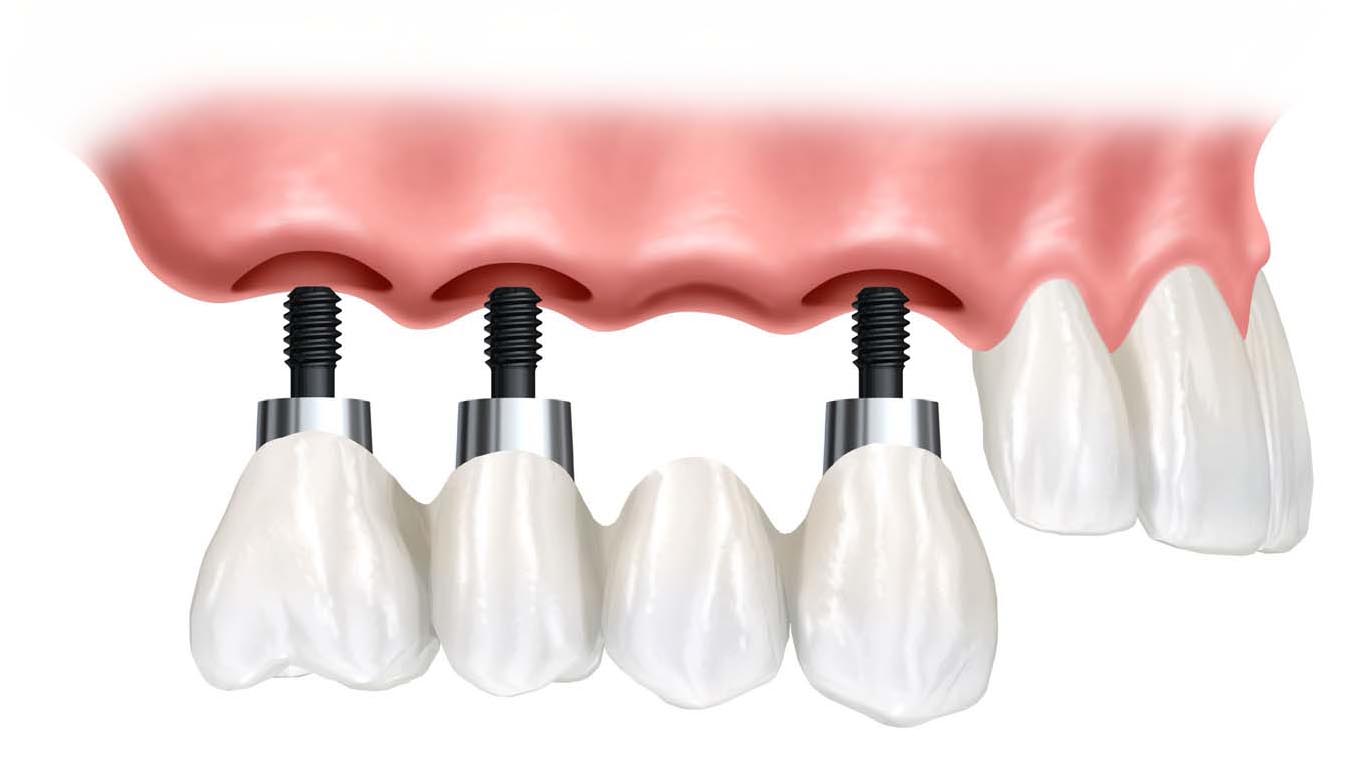
Removable Implant-Supported Tooth ReplacementRemovable dentures are often used to replace extensive tooth, bone and gum-tissue loss, thus providing support for the facial skeleton, lip and cheeks. A new denture can have attachments that snap or clip it into place on the implants or a custom made, milled bar can be fabricated to create additional strength and support for the restoration.

Missing all teeth
Implant support full bridge
In this case, six to eight dental implants are used to replace all missing teeth.
Implant supported Full mouth denture

 |
In this case, two to four dental implants are used to to retain a more natural biting and chewing capacity |
|
Mini-implant is used in patient having thin and small alveolar ridge. This might be alternative option to avoid bone graft, reduce treatment time and cost of treatment |
 |
Why do we need bone grafting?
Dental implant need bone support around it. However, when tooth is extracted, the bone is resorpted naturally. This cause bone ridge in some area too thin and too small for implant size. Bone grafts are carried out to increase the width and height of the jawbone at the implant site.


How to maintain the implant?
Implants do require maintenance. It is important to practice good daily oral hygiene, including brushing and flossing to control bacterial biofilm. It is also important to see your dentist and dental hygienist. Special instruments are necessary to clean dental implants that will not damage their metal surface beneath the gum tissues. Your dentist will need to monitor your implants to make sure the integrity of the osseointegration is stable, and that the implant crowns, bridgework or dentures are functioning adequately.


